Are your hormones all over the place, your sleep falling apart, and your emotions harder to manage than before? If you’re in perimenopause or menopause, you might feel like a stranger in your own life — overwhelmed, exhausted, and unsure what’s happening to your body. This Online Perimenopause & Menopause Therapy Group is here to help you make sense of it all.
This is a 10-week skills group for women and people assigned female at birth, offering a clear, supportive path forward.
Each week, you’ll learn the neurobiology behind what you’re experiencing along with practical skills you can apply in your daily life — helping you build momentum, regain balance, and feel more like yourself again.
And most importantly — you don’t have to go through this alone.

What You’ll Experience in This Online Perimenopause & Menopause Therapy Group
- A supportive therapy group environment where you’re not alone
- Guidance from a trained mental health professional
- Practical tools to manage menopause or perimenopause symptoms
- A deeper understanding of your body and emotions
- Space to share, learn, and reconnect with yourself
Who This Is For
This menopause or perimenopause therapy group online is ideal for:
- Women and those assigned female at birth
- Those in medically induced menopause or perimenopause
- Those experiencing anxiety, mood swings, or irritability
- Anyone struggling with sleep, fatigue, or brain fog
- Individuals looking for structured, professional support

Clinician Supported Therapy Group
Heather Chavin focuses on the intersection of the mental health impact and physiological reality of perimenopause and menopause. She helps clients understand how their nervous system is reacting to hormonal shifts. It isn’t about “trying harder.” It’s about understanding the biology behind fatigue, weight gain, mood changes and brain fog and using evidence-informed tools to stabilize and thrive.
Supervised by Naamith Heliblum, PhD, Supervisor
Location & Access
This is a fully online menopause therapy group, hosted by Joyful Living Behavioral Health clinic based in Eugene, Oregon.
Register Now
Call: 541-505-8168
Or visit: https://joyfullivingbh.com/contact/
Perimenopause & Menopause: It’s Not Just in Your Head
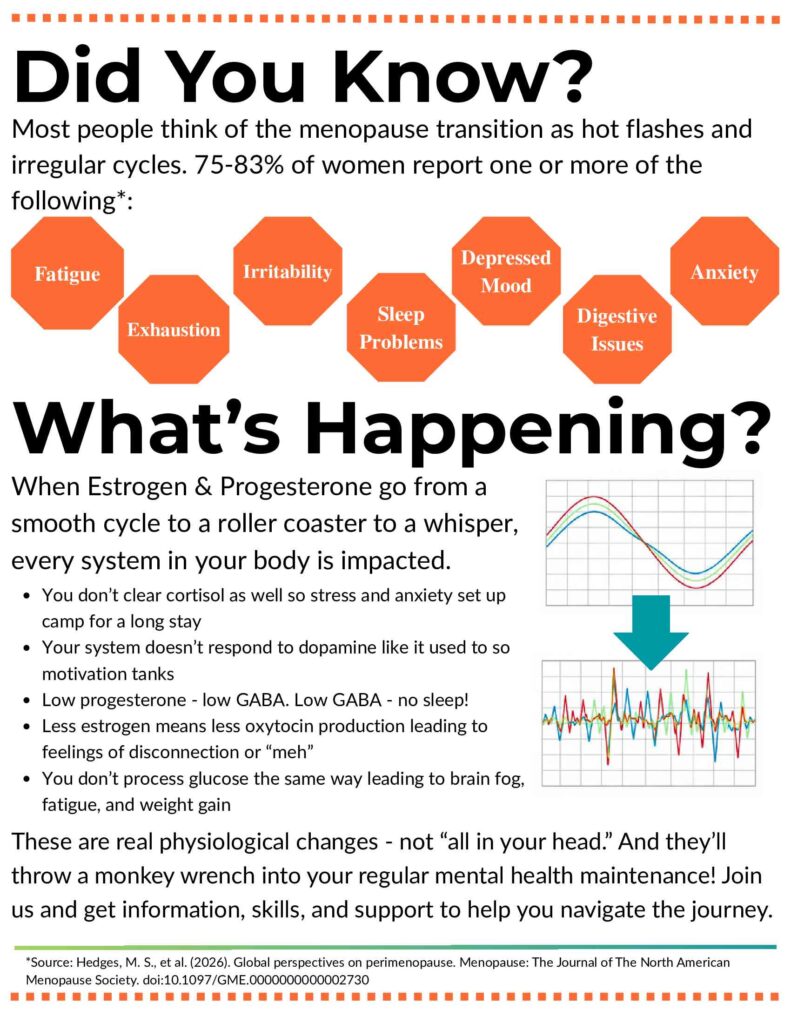
Many people think menopause is only about hot flashes or irregular cycles — but menopause symptoms go far beyond that.
Research shows that 75–83% of women going through menopause experience multiple symptoms, including:
- Fatigue and exhaustion
- Irritability
- Anxiety
- Depressed mood
- Sleep problems
- Digestive issues
Many women benefit from counseling for anxiety and therapy for depression to better manage these changes.
What Happens During Perimenopause & Menopause
During menopause and perimenopause, fluctuations in estrogen and progesterone affect nearly every system in your body.
As a result, menopause can impact:
- Stress levels and anxiety, which can be supported through cognitive behavioral therapy (CBT)
- Emotional regulation and mood swings, often addressed with dialectical behavior therapy (DBT)
- Sleep and relaxation, where mindfulness-based therapy can be helpful
- Feelings of disconnection and overwhelm, which can improve with emotion-focused therapy
Why Perimenopause & Menopause Feels This Way
These menopause symptoms are real physiological changes — not “all in your head.”
Hormonal shifts during menopause can affect your mental health, energy, and daily functioning more than most people expect.
Support for Perimenopause & Menopause Matters
Understanding menopause and its symptoms is the first step toward feeling better.
With the right support, tools, and guidance, you can manage menopause symptoms with more clarity, balance, and confidence.