
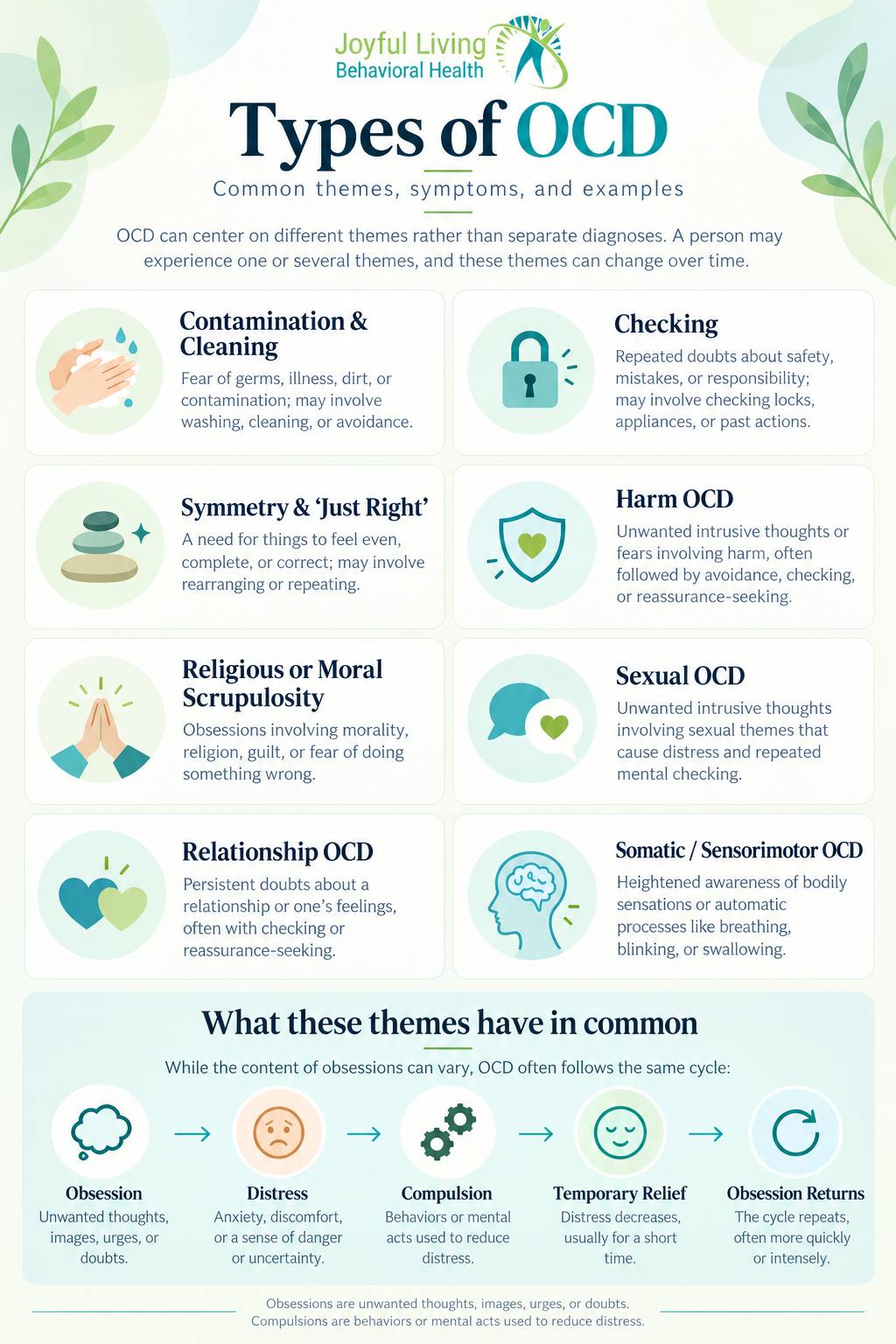
Obsessive-compulsive disorder (OCD) can look very different from one person to another, which is why people often search for the different types of OCD.
These types are better understood as common themes, such as contamination and cleaning, checking, intrusive thoughts, relationships, morality, or a need for things to feel “just right.” Understanding the types of OCD can make it easier to recognize how symptoms may show up in everyday life. If OCD symptoms are causing distress or interfering with daily routines, OCD therapy in Eugene, Oregon can provide support tailored to the individual.
What Are the Different Types of OCD?
There is no official fixed number of OCD types. Instead, the term “types of OCD” is commonly used to describe recurring themes that obsessions and compulsions may center around.
Common OCD themes include:
| OCD Theme | What It May Involve |
|---|---|
| Contamination and Cleaning | Fears involving germs, illness, dirt, or contamination |
| Checking | Repeated doubts about safety, mistakes, or responsibility |
| Symmetry and “Just Right” | A need for things to feel even, complete, or correct |
| Harm OCD | Unwanted thoughts or fears involving harm |
| Religious or Moral Scrupulosity | Obsessions involving religion, morality, guilt, or doing something wrong |
| Sexual OCD | Unwanted intrusive thoughts involving sexual themes |
| Relationship OCD | Persistent doubts centered around a relationship |
| Somatic or Sensorimotor OCD | Heightened awareness of bodily sensations or automatic processes |
A person may experience one theme, several themes at the same time, or notice that the focus of their OCD changes over time.
Common OCD Themes and What They Can Look Like
1. Contamination and Cleaning OCD
Contamination OCD can involve intense concerns about germs, illness, bodily fluids, chemicals, dirt, or other perceived sources of contamination.
This may look like repeated handwashing, cleaning objects multiple times, frequently changing clothes, or avoiding certain people, places, or objects.
Contamination concerns are not always about visible dirt or germs. Some people may experience a strong feeling of being contaminated even when there is no obvious physical source.
Washing and cleaning are among the commonly recognized compulsive behaviors associated with OCD, according to Mayo Clinic.
2. Checking OCD
Checking OCD often centers on uncertainty about whether something is safe, whether a mistake has been made, or whether something bad could happen.
A person might repeatedly check that a door is locked, an appliance is turned off, or a message was written correctly. Checking can also happen mentally, such as repeatedly reviewing a conversation or event to determine whether something went wrong.
Checking something occasionally is normal. With OCD, however, the behavior may become repetitive, time-consuming, and difficult to resist.
3. Symmetry and “Just Right” OCD
This OCD theme can involve a strong feeling that objects, movements, words, or actions need to be arranged or performed in a particular way.
It might look like rearranging objects repeatedly, performing an action a certain number of times, or starting something over because it did not feel complete or “right.”
This is different from simply liking things neat or wanting to do something perfectly. The person may experience significant discomfort or distress until things feel balanced, complete, or correct.
Mayo Clinic also distinguishes OCD symptoms from ordinary perfectionism or simply having high standards.
4. Harm OCD
Harm OCD involves unwanted intrusive thoughts, images, or fears related to harming oneself or another person.
These thoughts may feel especially distressing because they often conflict with the person’s values and intentions. Compulsions can include avoiding certain situations, checking behavior, mentally reviewing past actions, or repeatedly seeking reassurance.
Intrusive thoughts associated with OCD are typically unwanted and distressing and should not automatically be interpreted as evidence of a person’s wishes or intentions.
For a more detailed explanation of this theme, read What Is Harm OCD?.
5. Religious or Moral Scrupulosity
Scrupulosity involves OCD symptoms centered on religious, ethical, or moral concerns.
Someone may become preoccupied with whether they have sinned, violated their values, offended someone, or behaved in a morally unacceptable way.
Compulsions might include repeated prayer, confessing, mentally reviewing past actions, or repeatedly asking others for reassurance.
The International OCD Foundation describes scrupulosity as a form of OCD in which obsessions and compulsions can center around religious or moral fears.
What separates scrupulosity from ordinary religious or moral reflection is the recurring cycle of doubt, distress, and attempts to achieve certainty.
6. Sexual OCD
Sexual OCD can involve unwanted sexual thoughts, images, or doubts that cause significant distress.
Someone may repeatedly analyze what a thought means, check their emotional or physical reactions, avoid certain situations, or mentally review previous experiences in an attempt to gain certainty.
Because these thoughts can feel deeply personal or uncomfortable, some people may hesitate to discuss them. However, OCD obsessions can involve unwanted sexual themes, just as they can involve harm, religious concerns, contamination, or other subjects.
The important distinction is that intrusive thoughts are unwanted and can cause significant anxiety or distress.
7. Relationship OCD
Relationship OCD, often referred to as ROCD, involves persistent doubts centered around a romantic relationship.
A person might repeatedly question whether they truly love their partner, whether their partner is right for them, or whether the relationship feels exactly as it should.
Compulsions may include repeatedly checking feelings of attraction or affection, comparing the relationship with others, researching relationships online, or frequently asking friends or partners for reassurance.
Occasional relationship doubts are normal. With OCD, however, these doubts and attempts to resolve them can become persistent, distressing, and difficult to disengage from.
8. Somatic or Sensorimotor OCD
Somatic or sensorimotor OCD is an informal term used for OCD symptoms centered on heightened awareness of bodily sensations or automatic processes.
These may include becoming unusually focused on:
- Breathing
- Blinking
- Swallowing
- Heartbeat
- Eye movements
- Other bodily sensations
A person may begin monitoring the sensation repeatedly or worry that they will never stop noticing it.
The more attention they give the sensation, the more noticeable it may seem, which can reinforce the cycle of monitoring and distress.
What About Superstitious or Magical Thinking?
Some people with OCD may experience magical thinking, where they feel that performing or avoiding a particular action could prevent an unrelated negative event.
For example, someone might feel compelled to repeat a phrase a specific number of times or avoid certain numbers because they fear something bad could happen otherwise.
These experiences can overlap with checking, counting, symmetry, or “just right” OCD rather than representing an entirely separate diagnosis.
Hoarding-related symptoms may also occur in people with OCD. However, hoarding disorder is recognized as a separate condition, even though it falls within the broader group of obsessive-compulsive and related disorders.
Can You Have More Than One Type of OCD?
Yes. OCD does not necessarily stay within one theme.
Someone may experience contamination concerns alongside checking behaviors, for example, or relationship-related obsessions alongside moral scrupulosity.
The focus of OCD can also change over time. Someone whose symptoms once centered mainly on checking may later experience intrusive thoughts related to harm, relationships, morality, or another theme.
Mayo Clinic notes that both the types and severity of obsessions and compulsions can change over time.
That is one reason it can be more helpful to understand the overall pattern of OCD rather than trying to fit every person’s experience into one specific subtype.
What Do Different Types of OCD Have in Common?
Although OCD themes may look very different on the surface, they often follow a similar pattern:
Obsession → Distress → Compulsion → Temporary Relief → Obsession Returns
An unwanted thought, image, urge, or doubt may create significant discomfort or uncertainty. The person then performs a physical or mental compulsion in an attempt to reduce that distress or gain certainty.
The compulsion may provide temporary relief, but the uncertainty often returns. This can reinforce the urge to perform the same behavior again when the obsession appears.
Understanding this pattern is an important part of recognizing how OCD can continue even when the specific subject of the obsession changes.
Obsessions vs. Compulsions
Obsessions and compulsions are connected, but they are not the same thing.
Obsessions are recurring, unwanted thoughts, images, urges, or doubts that can cause significant distress.
Compulsions are repeated behaviors or mental acts performed in response to that distress, often in an attempt to reduce anxiety or prevent a feared outcome.
| Obsession | Possible Compulsion |
|---|---|
| Fear of contamination | Repeated washing or cleaning |
| Fear that a door is unlocked | Repeatedly checking the lock |
| Feeling that something is uneven | Rearranging or repeating |
| Fear of having made a serious mistake | Reviewing events or seeking reassurance |
| Intrusive fear involving harm | Avoidance, checking, or mental reviewing |
Compulsions are not always visible. Mental reviewing, repeating words silently, analyzing thoughts, or repeatedly seeking certainty can also become part of the OCD cycle.
When Might OCD Symptoms Need Professional Support?
Experiencing an occasional intrusive thought or double-checking something does not necessarily mean someone has OCD.
It may be helpful to speak with a mental health professional when obsessions or compulsions:
- Take up a significant amount of time
- Cause persistent distress
- Interfere with work, school, relationships, or everyday routines
- Lead to frequent avoidance
- Feel increasingly difficult to resist
OCD symptoms can significantly affect daily activities and quality of life when they become severe or time-consuming.
A mental health professional can also help determine whether symptoms are related to OCD, anxiety, or another condition with overlapping features.
How Are Different OCD Themes Treated?
Treatment is based on the individual’s symptoms and needs rather than simply the name of an OCD theme.
Exposure and Response Prevention (ERP) is a specialized form of cognitive behavioral therapy commonly used in OCD treatment. ERP generally involves gradually approaching thoughts, situations, or triggers associated with OCD while learning to reduce or resist the usual compulsive response.
The International OCD Foundation identifies ERP as an evidence-based treatment for OCD.
Other treatment approaches may also be considered depending on a person’s symptoms, circumstances, and clinical needs.
You can also learn more about Cognitive Behavioral Therapy at Joyful Living and how this approach may be used as part of individualized mental health treatment.
Frequently Asked Questions About Types of OCD
How many types of OCD are there?
There is no official fixed number of OCD types. Terms such as contamination OCD, checking OCD, harm OCD, and relationship OCD are commonly used to describe recurring themes within OCD rather than separate diagnoses.
What are the four main types of OCD?
There are not four officially recognized types of OCD. Some research and educational resources group OCD symptoms into broad dimensions, but OCD can involve many different themes, including contamination, checking, symmetry, harm, intrusive thoughts, morality, relationships, and others.
Can you have more than one OCD theme?
Yes. A person may experience several OCD themes at the same time, and themes can overlap.
Can OCD themes change over time?
Yes. The content of a person’s obsessions and compulsions can change over time even when the underlying OCD pattern remains similar.
Is Pure O a type of OCD?
“Pure O” is an informal term often used to describe OCD where intrusive thoughts appear more prominent than visible compulsions.
However, someone described as having Pure O may still engage in mental compulsions such as reviewing memories, analyzing thoughts, repeating phrases mentally, or seeking certainty. For that reason, the term can sometimes create the misleading impression that compulsions are completely absent.
Finding Support for OCD in Eugene, Oregon
If intrusive thoughts, repetitive behaviors, or persistent doubts are interfering with everyday life, professional support can help you better understand what you are experiencing and explore appropriate treatment options.
Joyful Living Behavioral Health provides OCD therapy in Eugene, Oregon alongside support for a range of mental health concerns.
If you would like to ask about available therapists or treatment options, contact Joyful Living Behavioral Health.
Sources
- Mayo Clinic
- International OCD Foundation
- National Institute of Mental Health


